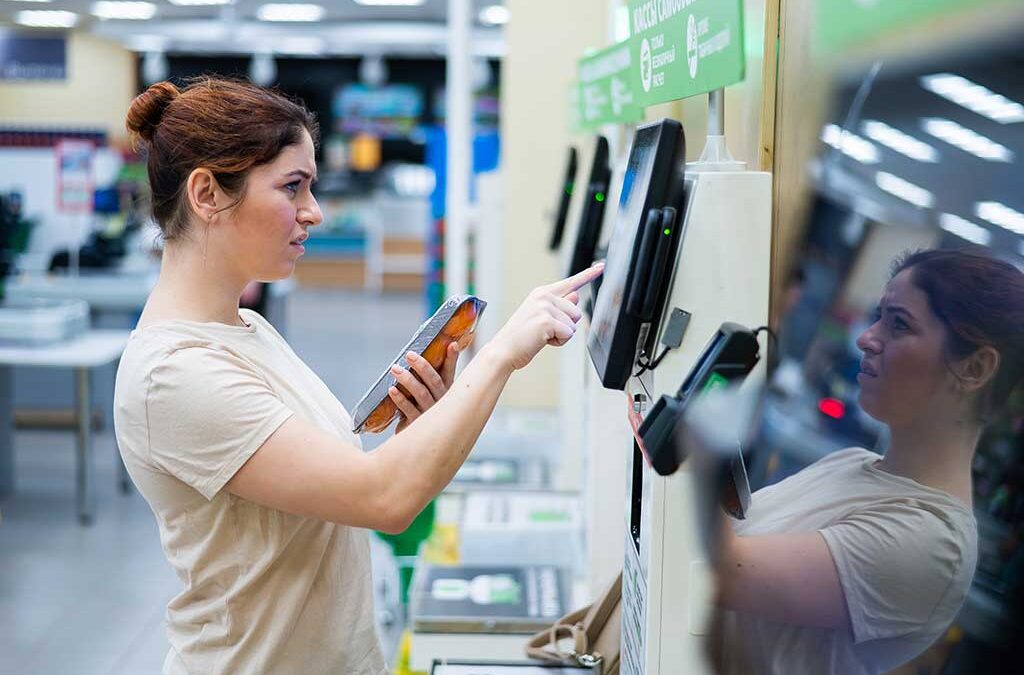
Walking through airports this past week, it seemed like every terminal had a new store featuring Amazon’s “Just Walk Out” equipment. As their website says, the technology “lets consumers enter a store, grab what they want, and get going.” In the ever-evolving business landscape, the introduction of self-checkout systems was hailed as a breakthrough in customer convenience and operational efficiency – and this approach of Amazon for in-store retailing takes it to another level.
And while shopping there makes for a unique experience, it frankly also left me a little cold. No one to help…no one to say, “Thank you for shopping with us.”
My feeling of being underwhelmed by the self-serve shopping experience ties in with recent studies and observations, suggesting a nuanced impact on customer loyalty — a cornerstone for business success.
Businesses of all types who have leaned heavily into self-service technologies are finding that, while these systems offer speed and efficiency, they may also be inadvertently eroding the personal touch that fosters customer loyalty. According to a report by RBR, global installations of self-checkout systems increased by 10% in 2020 alone, signaling a growing trend in the industry.
However, this shift towards automation has brought with it an unexpected challenge: a potential decline in customer loyalty.
A study by Harvard Business Review highlights the importance of human interaction. It found that customers who had a personal interaction with a staff member were 23% more likely to return to the store. This statistic underscores the value of human engagement in creating a memorable and loyal customer base.
A major supermarket chain known for its extensive use of self-checkout systems observed a gradual decline in repeat customers. An internal survey revealed that 35% of customers felt less connected to the brand due to the impersonal nature of self-checkout.
In contrast, a regional grocery chain that focused on personal service over automation reported a 15% increase in customer retention over two years. Their approach included trained staff at checkout points, offering assistance, and engaging with customers, which significantly enhanced the shopping experience.
The LeBow College of Business at Drexel University examined how grocery store self-checkout systems influenced customer loyalty compared to regular checkout systems. Yanliu Huang, Ph.D. and Farhana Nusrat, Ph.D., discovered that loyalty and repeat business decreased among customers using self-checkout – and the disconnection was higher the more items the customer purchased.
In other words, the better the customer, the less likely they were to return to do more business with you after they used self-checkout.
The key for any business to create an Ultimate Customer Experience® is to find the right balance between technological efficiency and human interaction.
For instance, introducing a hybrid model where self-checkout is available alongside traditional manned checkouts can cater to diverse customer preferences. Additionally, employing technology to enhance personal service, such as mobile apps that offer personalized recommendations or assistance, can bridge the gap between efficiency and personalization.
Looking forward, every business must discover how to navigate the delicate balance of integrating technology while maintaining the human element that fosters customer loyalty.
As noted by a Fortune 500 CEO, “The ultimate customer experience is not just about the efficiency of the transaction, but the emotional connection made during the process.”
Customer loyalty is not just about the product but also about the overall experience.
The challenge lies in integrating technology in a way that enhances, rather than replaces, the personal service that customers value. By doing so, businesses can create an experience that is not only efficient but also emotionally rewarding, fostering a loyal customer base in an increasingly competitive market.
How can we help you create distinction and deliver the Ultimate Customer Experience®? From ongoing consulting and in-depth training programs to dynamic keynote speeches and interactive workshops, we stand ready to take your organizational culture to the iconic level!
Almost everyone with a few years of experience and who shares a comparable profession to mine – speaking for corporate conferences and consulting and training in sales and customer experience – will have a similar story.
Somewhere along the way, we encountered the executive who told us, “We had to make some serious budget cuts this year. Therefore, there’s no alternative, and we must slash our expenditures on training and corporate events – particularly outside speakers.”
While I acknowledge considerable prejudice around this topic, I believe this approach is flawed and terrifically short-sighted.
And while this commitment to ongoing education and inspiration for your entire team is essential, the impact of training and development on Millennial and Gen Z workers is particularly significant, as these generations have distinct expectations and values regarding their careers and workplace environments.
Deloitte’s Millennial Survey found that 44% of Millennials and 49% of Gen Zs believe continuous learning is the key to a successful career. This demonstrates their keen interest in continuously acquiring new skills and knowledge.
A study by ManpowerGroup shows that Millennials prioritize learning over other benefits in a job. 93% want lifelong learning and are willing to spend their own time and money on further training.
Investing in training and outside perspectives is not just an expense; it’s a critical component for driving revenue growth and ensuring long-term business success.
Here are five reasons why:
1. Enhancing Employee Skills and Productivity
Investing in employee training is vital for any organization aiming to stay competitive. An Association for Talent Development report found that companies offering comprehensive training programs have 218% higher income per employee than those with less comprehensive training. Moreover, these companies enjoy a 24% higher profit margin than those who spend less on training. This data underscores the direct correlation between employee training and an organization’s financial performance.
The impact of training and development on Millennial and Gen Z workers is particularly significant, as these generations have distinct expectations and values regarding their careers and workplace environments. Investing in their growth is not just a perk; it’s a crucial factor in attracting and retaining these younger talents.
A LinkedIn Workplace Learning Report revealed that 94% of employees would stay at a company longer if it invested in their career development. This sentiment is even stronger among Millennials and Gen Z, who prioritize personal growth and career development.
According to a Gallup report, 87% of Millennials rate “professional or career growth and development opportunities” as important to them in a job, far higher than the 69% of non-Millennials who say the same.
2. Fostering Innovation and Adaptability
In a world where change is the only constant, organizations must be agile and innovative to create distinction and stand out in their marketplace.
Selecting the right outside speakers, consultants, and training programs brings fresh perspectives and ideas that can spark innovation within a company. They can challenge conventional thinking and encourage employees to think outside the box, leading to new processes and approaches that drive revenue growth.
3. Enhancing Employee Engagement and Retention
It just makes sense that engaged employees create higher customer satisfaction and are more productive — which in turn boosts revenue. A Gallup study revealed that highly engaged teams show 21% greater profitability.
In my experience, delivering educational programs of quality not only enhances employee skills but also means employees feel the organization cares about their growth – making them more engaged. In a recent series of programs I delivered in the healthcare industry, one of the main comments from participants was that they loved the series of programs because it displayed that their company was willing to invest in them with high-quality and custom educational content.
4. Building a Strong Corporate Culture
Training and events featuring outside speakers can significantly contribute to building a strong, positive corporate culture. They provide opportunities for team building and shared learning experiences, reinforcing the company’s values and vision. A strong corporate culture is not just about employee satisfaction; it’s a business strategy.
Research by Deloitte found that organizations with a strong culture have a 4X higher revenue growth compared to those with a weaker culture.
A study by TINYpulse found that professional growth opportunities are the top factor in employee happiness for Millennials. This is a significant shift from previous generations, who placed higher value on salaries and job security.
The 2021 Deloitte Global Millennial and Gen Z Survey reported that during the COVID-19 pandemic, Millennials and Gen Zs showed a strong preference for employers who offered skills training, especially those that could be done remotely.
5. Enhancing Customer Satisfaction and Loyalty
Finally, well-trained employees are better equipped to meet and exceed customer expectations, increasing customer satisfaction and loyalty. This is particularly true in service-oriented industries where the customer experience is paramount. According to a study by the Institute of Customer Service, there is a clear link between employee engagement, customer satisfaction, and revenue growth. The study found that a 1% increase in employee commitment (a proxy for engagement) can lead to a monthly increase of 9% in sales.
Think about it…
Cutting budgets for training and outside perspectives might seem like a quick fix for financial challenges, but it’s a counterproductive strategy in the long run.
The evidence is clear: investing in training and external insights is not just beneficial; it’s essential for driving revenue growth and ensuring the sustainable success of an organization.
Leaders who recognize and act on this will position their companies to thrive in an ever-changing business environment.
If you and your organization would like to join the long list of distinctive companies of all sizes that have benefited from our programs – from keynote speeches to in-depth training – on distinctive sales strategies and delivering the Ultimate Customer Experience®, please connect with us here! We would love to help you, too, grow revenue and profitability!
On a recent trip to the Big Island of Hawaii, Tammy and I thought we would take a look at interval ownership vacation properties — perhaps better known as a timeshare. We realize that traditionally, this field has a bad reputation. However, we thought it was worth a couple of hours to see for ourselves if the approach would be different and the process had improved.
When the shuttle we thought was going to pick us up failed to appear, I called the reception desk to let them know we were running late. The receptionist asked, “Do you have a rental car?” When I replied that we did, she said curtly, “So, why didn’t you drive here rather than have us pick you up?”
My response was that they didn’t know whether we had a car or not — and as the customer, I should get the opportunity to make the decision on our transportation. Believe it or not, she hung up on me!
Upon arrival, we were met by our sales advisor. He started by addressing concerns we had not even voiced — the reputation of high-pressure tactics and more. He was reassuring and captured our interest.
After showing us a unit like the one we might invest in, his manager came in to talk with us. Despite our insistence that we would consider our decision over the three days we were at the adjoining hotel, she repeatedly inquired, “What can we do to make you owners TODAY?” The pressure was insistent and off-putting.
The tactic made us dig in our heels and refuse to make a decision. In other words, it had exactly the opposite effect that she desired.
Then we were taken into another room to be offered an alternative. When we entered, we could not help but notice that several of the bulbs in the chandelier were burned out and had not been replaced. As prospective customers, we asked ourselves, “If they can’t take care of their own offices…how much care will the maintenance show our timeshare?”
We did not purchase. In part, it was because of the high pressure tactics that simply do not work in today’s marketplace. But it was also an example of how the “little things” make a huge difference to customers.
In other words, the minutiae often define the customer experience more than grand gestures. Here are six reasons why:
1. First Impressions: Little things like a clean environment or a fully functional facility contribute to a customer’s immediate assessment. The Halo Effect suggests that one positive aspect can make everything else seem better. When a customer walks into a pristine environment, they’re more likely to have a positive view of the entire brand.
2. Psychological Comfort: According to Maslow’s Hierarchy of Needs, physical and safety needs come first. A clean, well-maintained space appeals to these basic human requirements, increasing the chances of customers feeling comfortable enough to engage more deeply with your business.
3. Attention to Detail: Harvard Business Review points out that customers value “effortless experiences.” If light bulbs are out or the surroundings are dirty, it indicates a lack of attention that might extend to your products or services.
4. Consistency: In a world where consumer expectations are ever-evolving, reliability is king. According to a PwC report, 65% of U.S. consumers say a positive experience with a brand is more influential than great advertising.
5. Word of Mouth: In an American Express Survey, 65% of participants said they’ve spoken to others about a bad experience, but they’re also likely to share positive experiences. Good experiences with attention to small details get amplified in this age of social media, offering free advertising and genuine endorsements.
6. Up-sell and Cross-sell Opportunities: A CX Intelligence Report suggests that customers who’ve had a good overall experience are 74% more likely to be open to add-on sales. Ensuring the basics encourages people to stick around longer, increasing their lifetime value to the business.
Mastering the little things isn’t just good housekeeping; it’s a strategic move that impacts customer perception, loyalty, and ultimately, your bottom line.
Creating the “Ultimate Customer Experience®” would have improved the opportunity for this group to make a significant sale. The problem is they weren’t aware that these “small” elements can make a world of difference.
Are you taking care of the small aspects that can mean big sales and create distinction for your organization?
Earlier this week, a great friend of mine was subjected to negative comments on social media. The reason some cited was that she was a “phony” — because she always seemed so upbeat. As I posted, it struck me that we never say a negative person is a phony. That critique seems reserved for those who choose to express an optimistic attitude.
However, my experience and research has taught me that in the quest for distinction within any organization, one vital component resonates at the core of success: a positive attitude. A company with a culture infused with optimism doesn’t just thrive, it stands out. Here are six reasons why this essential aspect is pivotal in creating a distinctive business culture, no matter the size of your company.
1. Unleashing Potential
A positive attitude unshackles potential. It energizes, motivates, and inspires employees to transcend the ordinary. It’s about seeing challenges not as roadblocks, but as gateways to creativity and innovation. A culture of positivity instills a sense of purpose, propelling an organization towards distinction.
2. Strengthening the Customer Experience
As someone who has extensively studied, written, and spoken about organizational distinction and customer experience, I firmly believe that positivity is integral to delivering the Ultimate Customer Experience®. When positivity permeates a company, it’s felt by every customer. It translates to engaged employees, superior service, and ultimately, customer loyalty. The connection between a positive attitude and customer experience isn’t just theoretical – it’s proven, tangible, and transformative.
3. Cultivating Collaboration
Positive attitudes foster an environment of collaboration and inclusiveness. Diversity and unity thrive in an optimistic setting. Team members feel valued and respected, leading to stronger collaboration. This creates a synergy where the collective wisdom transcends individual capabilities.
4. Building Resilience
In the ever-changing global business landscape, resilience is a prized attribute. My friend, speaker, author, and someone who has conquered physical disabilities, Roger Crawford always states that a positive attitude equips an organization with the flexibility to adapt and the strength to endure. It breeds a culture where failure is seen not as a dead end but as a lesson learned, a stepping stone towards success and distinction.
5. Enhancing Profitability
Numerous studies from respected sources affirm that companies fostering a positive culture enjoy higher levels of productivity and profitability. Gallup, for instance, found that companies with engaged employees outperform others by 202%. A positive attitude is not just a moral booster; it’s a strategic business tool.
6. Becoming Iconic
As I’ve highlighted in my book, “ICONIC,” becoming an iconic organization requires commitment, effort, and a clear vision. A positive attitude is the fuel that powers this journey. It’s the beacon that guides a company from mediocrity to greatness.
The Positive Path to Distinction
Creating distinction is not about mere survival; it’s about standing out and thriving. It’s about embracing a positive attitude that sets the tone for excellence in every facet of the organization.
A positive attitude is not a by-product of success; it’s the foundational element. It’s what separates the good from the great, the ordinary from the extraordinary.
A positive attitude is not just the cornerstone of a distinctive company culture. It’s the heartbeat, the lifeblood, and the soul.
It’s not about being phony and it’s more than a business strategy; a commitment to a positive approach is a philosophy that resonates with human potential and aspirations. By nurturing a culture of positivity, we pave the way for distinction, innovation, and growth.
Ask yourself who you would rather deal with as a customer or a colleague at work: someone who acts as if they have a positive attitude about your business…or a sincere jerk who doesn’t care about how you’re treated?
What I Discovered – and How it Impacts You – at the National Speakers Association Convention
I’m returning home from Orlando after attending the National Speakers Association’s 50th annual convention. (I frequently make the joke that it’s a conference with more than 1,000 speakers but no listeners.)
While it was a remarkable experience that allowed me to renew friendships with many of the top content creators and thought leaders worldwide, it also got me to consider a crucial issue: Why should a business owner or leader seek advice and input from someone outside her company?
It can be tempting to think that you have all the answers and that you can handle every aspect of your business on your own. You work in the business every day, and an outsider will never have the level of detailed knowledge of your specific business as you.
However, listening to outside expertise can provide valuable insights and help you make informed decisions that will ultimately strengthen your business. Here are five reasons why an outside consultant, author, or speaker can help you grow your business:
One of the main benefits of listening to outside expertise is that it allows you to gain a fresh perspective on your business. You may be too close to the day-to-day operations of your business, making it difficult to see areas for improvement. An outside coach, consultant, or speaker can bring a new set of eyes and a different perspective, helping you identify areas that you may have overlooked.
Industries are constantly evolving, and it can be challenging to keep up with the latest developments on your own. Outside expertise can help you stay up-to-date with the latest trends and best practices in your industry. An author, consultant, or seminar leader may provide you with valuable insights into what is working and what is not, helping you stay ahead of the competition.
Making better decisions is yet another advantage of seeking out outside knowledge. It is challenging to make choices that will impact the entire company when you are a business leader, as you have many responsibilities. An outside specialist may offer you data-driven insights and recommendations based on best practices in your sector, assisting you in making decisions that are best for your company.
Engaging outside expertise can help you improve your leadership skills. A business coach or mentor can provide you with guidance on how to motivate your team, communicate effectively, and build a positive company culture. They can also help you identify areas where you may be struggling as a leader and provide you with strategies to improve.
Finally, coaches, consultants, and speakers can help you increase your confidence as a business owner. When you work with an outside expert, you can rest assured that you’re getting the best advice and guidance possible. This can give you peace of mind and increase your confidence in running your business successfully.
Outside expertise is essential for building a stronger business. There were many experts at the National Speakers Association convention who could help you gain a fresh perspective, stay up to date with industry trends, make informed decisions, improve your leadership skills, expand your network, and increase your confidence. Don’t hesitate to seek out outside expertise – it could be the key to taking your business to the next level.
And, please remember – if you seek the insight of a consultant or coach, or if your next meeting needs a speaker – I’m here to help you create distinction and deliver an Ultimate Customer Experience.®
Several years ago, a Canadian musician’s $3500 Taylor guitar was severely damaged by baggage handlers from United Airlines. When Dave Carroll couldn’t get the airline to take responsibility for what they had broken, he made a music video that was viewed by millions on YouTube, creating a public relations nightmare for United.
Wikipedia reports, “It was widely reported that within four weeks of the video being posted online, United Airlines’ stock price fell 10%, costing stockholders about $180 million in value.” (That would’ve bought over 51,000 replacement guitars!)
I bring this up because a couple that lives near us in Las Vegas had a terrifying incident at a local Starbucks. Lauren Weyand writes on Nextdoor:
“5 or 6 teenage kids came in shirtless, shoeless, and screaming profanities at each other…using incredibly vulgar language and pulling all of the food products out of the fridge section with no intention to buy anything. They asked the cashier for large water, one for each of them. Each of them was given water. They were heading out of the store.
My husband saw them line up — waters in hand — and said, ‘Ready, go!’ Before I knew it, I was hit in the head with a water cup. Two large cups of water doused our computers and us. We were startled and overwhelmed by what had happened. The whole store acknowledged the incident and asked us if we were okay. The Starbucks staff said nothing and started mopping up the mess. Nobody contacted the police or managers to ask for help with the situation that had just occurred.”
Weyand continues that she and her husband later returned to Starbucks to speak to the manager about what had happened. They were told they could not have video of the incident, and no police report had been filed because an employee got tired of waiting for the police to answer the phone, so they hung up and didn’t try again. The manager then led them to the door and told them more information would be forthcoming.
Look, we could turn this issue into a political or generational topic and press hot buttons all day long. Let’s not – that isn’t what this commentary is about.
At the current point, the Weyands must buy two new laptop computers, as neither of the ones they were using at Starbucks is now working because of the water damage. The Starbucks helpline – using the term “help” a bit loosely here – told them the case was closed and had been resolved, even though nothing was truly handled. From Weyand’s perspective, Starbucks has chosen the profane, shirtless troublemakers who threw water in their store over two loyal customers.
When I contacted Lauren Weyand, she confirmed that Starbucks remains silent – which she understandably perceives as a lack of concern and commitment for their customers.
In the frequently negative world of social media, some are questioning if Starbucks has any liability in this matter. I’m not a lawyer, so I don’t know the correct answer – but the important issue is that we should care less about liability and be more concerned about the customer experience.
What did United do in the wake of the PR disaster over the music video, “United Breaks Guitars”? As I relate in my new book, “The Ultimate Customer Experience,®” they licensed the video from Carroll to use in their training curriculum. They’ve hired him to speak at meetings for them to emphasize the importance of the customer experience.
And United’s share price has gone from $3.25 when Carroll’s video was the hottest thing on YouTube to closing today at $53.34! That’s what happens when you listen to your customers, learn from your mistakes, set things straight with those you have wronged, and focus on the Ultimate Customer Experience!
Starbucks may save a couple of grand by staying silent and not offering the Weyands replacement laptops, hoping they’ll just give in and give up. But just like United discovered how they could be “penny wise and pound foolish,” we’ve seen from experience that ANY business, no matter their size, can get on the wrong side of the public and lose millions when basic empathy and concern for the customer is ignored.
Every customer has a right to presume they aren’t going to have water thrown at them and have their computers ruined because they chose to do business with you.
So, what should Starbucks do? I’d suggest the minimum is that they apologize, replace the laptops, and provide the Weyands with a couple of gift cards with handsome amounts attached.
(They might also increase security so that shirtless, shoeless individuals can’t enter their stores in violation of health ordinances…and provide the store’s video to the police so they can press charges.)
Starbucks should learn from its mistake. Because they didn’t get it right, they should take advantage of the opportunity to make it right. If they fail, they may discover more people than a nice couple here in Vegas who are beginning to question if it’s worth a trip to get coffee from them, as opposed to their competition, if the experience is going to be so inferior – even problematic.
(Full disclosure: I’ve had the privilege of working with United and consider their Chief Customer Officer, Linda Jojo, a friend.)
The Ultimate Customer Experience® book is now available – get yours today!