Business Distinction, ICONIC, Leadership, Personal Distinction
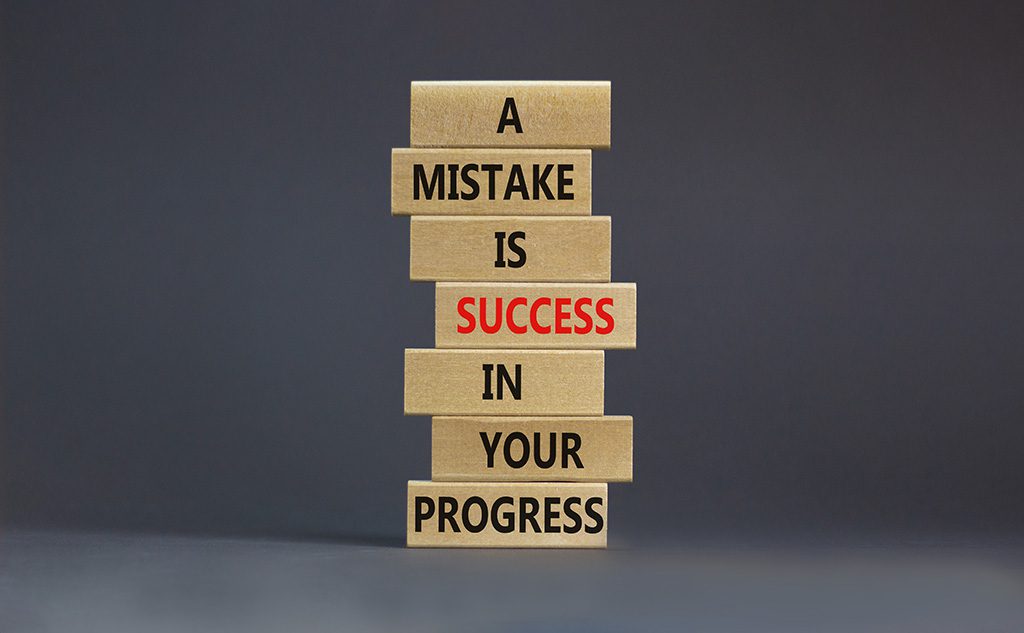
Mistakes are a natural part of life. We all make them — and goodness only knows, I have personally made more than my share!
One of the challenges in today’s world is the plethora of online “gurus” and so-called experts seeking to show you how to be successful, wealthy, famous, and anything else you’d want. Part of what they promise is that they’ll provide the solution to whatever your problem might be in business or life. Sometimes that message is wrapped in an air of invincibility that may lead some to imagine that their prospective teacher has never failed or made their own missteps – or that the teacher’s slight errors will prevent you from making any blunders of your own.
The difficulty with this approach — and I certainly hope I’m not guilty of it, as all I’m trying to do is deliver insights that will assist you — is that we all must make our own mistakes and learn from them in order to progress. Mistakes can teach us important lessons and help us to become better people.
Don’t get me wrong – I’m not suggesting that we should be out there intentionally making blunders! However, it’s impossible to stand out if we are in fear of not always being correct or impeccable. There are no distinctive organizations or leaders who haven’t made significant errors in judgement or choices at some point!
An essential step is understanding that personal responsibility is critical when it comes to moving up from mistakes. We must take ownership of our mistakes and learn from them. This process is not always easy, but it is essential for growth. Blaming others or our circumstances might make us feel momentary vindication for our errors, but it is also a roadblock to personal and professional development.
There is no one-size-fits-all solution for dealing with mistakes. What works for one person may not work for another. However, seven principles will help you find your way forward:
- Accept responsibility for your mistakes. This is the first and most crucial step. Denial will only prolong the pain and prevent you from learning the lessons you need to know. You must own up to your mistakes in order to move on from them.
- Acknowledge your mistakes to yourself and others. This can be difficult, but it is essential for rebuilding trust and relationships. Trust is vital for any healthy relationship. Honesty is always the best policy. It’s also a necessary aspect of building and maintaining trust with those you work with and live around.
- Seek forgiveness from those who you have harmed. This is not always possible or necessary, but it can be a helpful step in the process of moving on. Forgiveness can help to heal old wounds and allow you to move forward with your life.
- Learn the lessons your mistakes have to offer. Ask yourself what you can do differently in the future to avoid making similar mistakes. What went wrong? What could you have done differently? How can you prevent similar mistakes in the future? These are tough questions to answer, but they’re fundamental for learning and growth. Mistakes can teach us important lessons if we are open to learning from them.
- Seek out support from others. We all need, as the Beatles sang, a little help from our friends. Talk to someone you trust about your mistakes and how you’re feeling. This can be a great way to get some perspective and start moving on.
- Forgive yourself. This can be difficult but is essential. We all make mistakes; it’s part of being human. What counts is how we learn from our mistakes and become better people and professionals as a result. Obsessing over your errors with anger and resentment will only eat away at you and prevent you from moving forward.
- Put your mistakes behind you. Once you have learned from your mistakes and taken the previous steps listed here, it’s now time to put them behind you and move on. This doesn’t mean forgetting about what happened; it just means that you refuse to continue dwelling on it. As the old saying goes, there’s a reason the windshield is larger than the rearview mirror. You have to keep looking forward. Holding onto mistakes will only drag you down and prevent you from achieving your fullest potential.
My great friend, Skip Prichard, wrote a remarkable book about this subject — it’s even titled “The Book of Mistakes.” I highly recommend it.
Mistakes are a natural part of life, but that doesn’t mean we have to like them! As mentioned earlier, I’ve certainly made them — and will undoubtedly continue to do so. However, it’s impossible to create distinction without sometimes making a misstep. Move on from your mistakes and continue progressing in your personal and professional life.
One way to avoid unnecessary mistakes – or to maximize what you learn from them – is through professional coaching. We offer coaching to a limited, select few leaders. If you’d like more information on our Distinctive Coaching, just reach out to us and let’s talk!
ICONIC, Leadership, Personal Distinction
Make an enemy of certainty and befriend doubt. When you can change your mind, you can change anything.
Kevin Ashton
As Tammy and I sat in church this past Sunday, our minister, Vince Antonucci, began his sermon on a topic not often discussed in many religious services: the importance of doubt. Vince’s insights started me thinking about the importance of doubt — and why we should embrace ours.
Doubt creeps into our thoughts and lives in every regard — not just in religion and the meaning of life. We doubt our abilities as leaders, professionals, and parents. Typically, we try to eliminate all our doubts — but perhaps that is not the best course of action.
Doubt can be a healthy thing. It can help us examine our viewpoints and question whether they are accurate. Doubt can also lead to greater confidence because we know that we have thought through our positions and are not just blindly following them.
However, doubt can also be confusing and frustrating. It can make us feel like we are not good enough or are not progressing. If doubt is constant, it can lead to anxiety and paralysis.
“If a man will begin with certainties, he shall end in doubts; but if he will be content to begin with doubts, he shall end in certainties.” ― Francis Bacon
Here are three steps to dealing with doubt:
- Acknowledge your doubt. Everyone has doubts at times. Doubt is a normal part of the human experience. When you find yourself doubting your abilities, it is crucial first to acknowledge the feeling. Do not try to push the doubt away or ignore it. Just accept that it is there and allow yourself to feel it.
- Examine your doubt. Once you have acknowledged your doubt, you can then examine it. Examining your doubt means thinking through why you feel doubtful and what is causing the worry or fear.
- What is causing you to doubt yourself?
- Is there evidence to support your doubt?
- Or is your doubt based on irrational thoughts?
- Is there a specific event or situation that is making you question things? Or is it more generalized anxiety?
- Try to identify the source of the doubt and explore it further.
- Find a balance. Once you have examined your doubt, you can then work on finding a balance. It is essential to have some doubts in order to question our perspectives and ideas. But too much doubt can lead to paralysis and anxiety. Try to find the middle ground where you can listen to your doubts, but also trust yourself and your abilities.
It’s not my goal to make a political statement here, but I have to wonder if a bit of doubt and questioning of himself might have served Mr. Putin well in the current crisis. Many outside observers believe that he entered the current conflict with overwhelming (and inaccurate) certainty. It is also reported that he surrounds himself with “yes-men and women” who refuse to question or challenge his ideas and perspectives.
During the Cuban Missile Crisis, John Kennedy constantly challenged his advisors to offer contradictory viewpoints. He embraced doubt and rejected his Generals when they presented approaches with abject certainty. He relentlessly played the “what if” game with his team to analyze every possible move and potential response. The result is the world was spared a nuclear war.
Learn to listen to your doubts and question them. But also learn to trust yourself and your abilities.
It’s not that iconic professionals and leaders are without doubts. Instead, they know how to embrace and leverage their doubts into greater productivity and performance.
Business Distinction, ICONIC, Leadership, Personal Distinction
There are so many variables competing for our attention today it’s easy to get bogged down in the minor details and lose focus on what’s important. When trying to achieve a critical task, it’s crucial to stay focused and not let distractions get in the way.
It’s all too easy to let the minor things take priority over the significant goals. But if you want to succeed, you need to learn to control your focus and stay on track. Don’t let the minor things overshadow the major ones – focus on what’s important and achieve your goals! Only by keeping your eye on the prize can you achieve great things.
The late, great business philosopher, Jim Rohn, used to ask, “Are you majoring in minor things?” It’s a brilliant question. Frequently, we can get so caught up in the details that we overlook the primary purpose. We focus on the small aspects rather than what’s most important.
Remember, the first Cornerstone of Distinction is CLARITY! It’s essential to keep your priorities straight so you can create distinction. Knowing what is truly important makes it easier to stay focused and motivated.
- Stay in control of your focus, and don’t let distractions get in the way of your success.
“The more you know, the more you realize how much you don’t know.” – Aristotle.
Knowledge is the first step to power. The most innovative people are constantly learning and expanding their horizons. The more you learn, the better equipped you’ll be to focus on what’s important and achieve your goals. Don’t be afraid to ask for help – there’s no shame in admitting you don’t know everything.
The second step, however, is action. We often joke about being online and going “down the rabbit hole” — in other words, we get so distracted and engaged with the next link online or the next video on YouTube that we spend hours on the trivial than the vital. If knowledge were all that was necessary to achieve success, the center of the universe would be on college campuses.
Here are three steps to maintaining focus:
1. Know your priorities.
It’s only recently that the word “priority” also had a plural version. The word priority was created to signify the one aspect that was THE most important of all items we are considering. It’s essential to limit the number of items you’ll focus on — and know them thoroughly.
2. Stay disciplined
The importance of discipline is frequently underrated. It’s the ability to do what you should do when you should do it, whether you feel like it or not. It’s the key to achieving success and staying on track. Discipline allows you to focus on your goals and ignore distractions.
3. Take action!
With so many distractions today, it can be easy to lose focus on what’s important. If something is essential, you’ll find a way to get it done. But if you want to achieve great things, you need to stay focused and go to work! It’s up to you to take control of your focus and stay on track.
“What gets scheduled, gets done.” – Brian Tracy.
So, are you majoring in minor things? If you want to be successful, you must clarify what’s important and stay on track. Only by keeping your eye on the prize can you achieve great things.
- Don’t permit the minor aspects to overshadow the major ones – have clarity on what is important and achieve your distinctive goals!
Business Distinction, Customer Experience, ICONIC, Sales & Retail
At a recent event held at a Four Seasons hotel, an audience member for my keynote presentation came up following my program. “Hi,” he said, “I’m Jerry – and, boy, do I have a story for you!”
“Yesterday, my wife and I were dining at the breakfast buffet here at the Four Seasons,” Jerry told me. “As we proceeded down the line, I just happened to mention to my wife that I wished they had blueberries available. Don’t get me wrong — they had a beautiful array of fruit. It’s just that there weren’t any blueberries, which are my favorite!”
“Imagine my surprise,” Jerry continued, “when mere moments later, a Four Seasons team member came to our table with a bowl of the most beautiful blueberries you could imagine! A young lady happened to overhear my conversation with my wife. She told me, ‘We don’t want you to be disappointed with ANY part of your experience at Four Seasons!'”
As Jerry and I continued the conversation, he was supremely impressed with two aspects of this encounter:
- She listened to the customer.
- She took action to ensure the customer received exactly what he wanted.
Let’s examine both steps:
First, listening to the customer. This Four Seasons team member was tuned in to what Jerry wanted and needed. She didn’t just hear the words. She listened to the emotion behind them. Because she listened, she knew that blueberries were important to him and acted on it.
Listening is critical because it communicates to the customer that they are essential and that their wants and needs are a priority. How many times have you been in a customer service situation where you feel like you’re not being heard? We, as customers, feel like our voices are falling on deaf ears all too often. Too often, we as customer service professionals, stop at listening. We need to go the extra mile and take action to ensure that our customers receive what they want.
When we take the time to listen to our customers, it shows that we care about them and their experience.
Second, taking action to ensure the customer received exactly what he wanted. This Four Seasons team member not only listened but also took action to ensure Jerry’s happiness. She knew that blueberries were important to him, so she brought him a bowl of them.
Consider what the alternatives were for the employee —
- She could have been daydreaming or thinking about something else about her job and not tuned in to the customer.
- She could have thought, “We have LOTS of great fruit…and it’s not enough for this guy?”
- She could have told her manager, “By the way, a customer noted there weren’t blueberries. Maybe we should put some out tomorrow.”
Instead, she took ownership of the customer’s modest identification of a missing element.
Educating your team to own the problem and create the solution is critical.
Taking ownership of customer issues and being proactive in solving them is another hallmark of delivering a difference. Often, the small things that we do for our customers make the most significant impact.
Jerry’s story is an excellent reminder of how important it is to listen to our customers and take action on their behalf. When we do this, we deliver an Ultimate Customer Experience. What Jerry experienced was a great example of a UCE. His Four Seasons team member went the extra mile to ensure that he received exactly what he wanted.
Here’s an additional aspect — most of us know that this isn’t a unique experience for Four Seasons customers — it’s part of their DNA.
As my pal, Joe Calloway often discusses, most companies share an experience wildly out of the norm. They want you to know about the employee who walked a mile through the snow to be certain that a customer got their pack of chewing gum.
The problem is that the same store doesn’t do the basic blocking and tackling, which ensures that the little things are done right for every customer, every time.
Remember, customers do not want us to make it right. They want us to GET it right!
Because of the actions of this employee, Jerry left feeling appreciated and delighted with his experience at the Four Seasons. In fact, he was so impressed, he felt compelled to share his story with me — and now, I’m sharing it with you!
This is vitally important! When customers share your success stories, they become your advocates in a crowded marketplace. (And what business doesn’t want more advocates?)
When your team (and you) can deliver this level of customer experience, you’re well on your way to becoming ICONIC!
ALL Business is STILL Show Business, Business Distinction, ICONIC, Leadership, Sales & Retail
Here’s a problematic question for entrepreneurs and managers: is it that people don’t want to work nowadays? Or is it that they don’t want to work for YOU?
Twenty years ago, I wrote that you must provide the “Ultimate Experience” for both customers and employees. Over the past two decades, we’ve observed significant strides in how organizations engage their customers. Frankly, we haven’t seen that level of progress across the board regarding employee engagement.
In the United States, we’ve heard many leaders talk about how today’s employees don’t want to work and are lazy. Many studies are confirming this is not true. The companies and managers who have had problems with employee engagement have failed to create an environment where their staff was happy or felt it was a place they wanted to work.
To have a successful business, you need happy and engaged employees. It’s not only the right thing to do, but it’s also good for business. Employees who are disengaged cost businesses billions of dollars every year in lost productivity. Gallup has even gone as far as saying that employee engagement is the key to success for any organization.
Here are a couple of questions for you:
- Have you designed the employee experience with as much passion and precision as you plan customer acquisition?
- Have you developed a specific list of WHY both current and prospective employees would recognize working for you as a superior option from their other opportunities?
For most, frankly, the answer will be, “No.”
That needs to change — and it needs to change now if you want to attract and retain a superior team.
So, what can you do to create an environment where your employees want to work? It’s not easy and takes time, but here are five tips:
- Treat your employees with respect. This includes listening to them and considering their ideas.
- As I wrote in “ICONIC,” respect is reciprocal. If you want your team to respect and value you and your organization, you must display how you value and respect them FIRST.
- Make certain they feel appreciated. The best way to make your employees feel part of the company is by giving them ongoing recognition. In other words, leaders don’t recognize their work only when milestones are met or when achieving sales targets.
- Recognition can be in many forms, including praise for doing a job well done, even if it’s not on the radar screen yet.
- Offer them development opportunities. No one wants to feel like they’re stuck in a dead-end job.
- Employees want to know that there is room for growth and that they are valued enough for the company to invest in their future.
- Let them have some fun! Work can be stressful, so it’s essential to find ways for employees to let off some steam.
- Whether through social activities, team-building exercises, or just taking a break for a little bit, employees need to know that they can have fun at work and not be all work and no play.
- Finally, PAY MORE! My great pal, Randy Pennington, related a story on a recent live stream where we both were guests about a consulting client of his that dramatically increased the compensation of his team. Guess what? It SAVED him money!
- How could this be the case?
- He reduced his expenses of recruiting and onboarding new team members.
- He drastically reduced turnover.
- He kept his best employees and attracted top-level recruits.
- He prevented massive overtime outlays because he now had a productive team that could get the work done during regular hours.
- AND the fact that no one had to put in extra time meant happier employees and families.
The next time you think about how employees “just don’t want to work today,” remember it’s not because they’re lazy. It’s likely because they aren’t attracted to work for a company that they aren’t certain appreciates them or doesn’t have their best interests at heart.
Change your ways and see how your employees change their tune!
If you can successfully implement these tips, you’ll be well on your way to having an engaged and happy team!
Business Distinction, Customer Experience, ICONIC
At the risk of sounding somewhat like my Dad, who had to trudge to school, in the snow, barefoot, uphill in both directions: Today’s generation of employees want (some would say “require”) something different from the world of work that I never expected.
They want to do work that has meaning. Younger generations now want to know that their efforts for your organization are more purposeful. And they will not be satisfied with work for work’s sake.
Many organizations have a purpose, even one that might be virtuous and laudable. But your organization’s purpose can’t stop at the office door. It has to follow your employees home and inspire them in their personal lives—and it should do so in a way that makes sense from an employee perspective.
This purpose-inspired culture has become so important that it isn’t merely the very top – C-Suite leaders or business owners, for example — that need to buy into it; it has to be shared by all who work for you, managers and non-managers alike.
The organization’s greater purpose needs to leap from job descriptions and company mission statements and flow into employees’ consciousness 24/7, wherever they are.
This purpose-inspired culture will be critical to attracting the best of the Millennial generation (generally accepted as born between 1980 and 1997) and Gen Z (born 1998-2012), who expect meaning from their work–and who have a multitude of employment options. These generations know what they want, even if older generations of leadership and management do not yet know exactly how to help them get it.
Studies show that Millennials and Gen Z are searching for purpose in employment more than anything else–and not merely purpose at work, but purpose with their lives.
To borrow a phrase from the 1930s, purpose is the “New Deal” that young workers seek from today’s world of work.
Some would say purpose is the difference between being “engaged at work” and “having a job.” It is a purpose that engages employees and keeps them focused on their work, producing higher-quality outcomes, and staying committed to the organizations they work for in a manner that ensures they’re present for work tomorrow.
Purpose is no longer solely an HR issue: Purpose has become a business imperative.
From product development and marketing to operations and quality control, purpose is the New Deal. Every department and every business leader should explore purpose for their organizations and how they can market it to not only to Millennials and Gen Z– but also to existing experienced employees who may demand purpose in return for sticking around.
The purpose could be your organization’s mission or a purpose you apply to a specific unit. The purpose could be to do something worthwhile for the community or society at large, which is often a powerful draw for Millennials and Gen Z. Your organization’s purpose should be something that everyone can get behind.
Your purpose is not required to be altruistic, though. It can also be about an improved customer experience or a purpose-inspired product line. Purpose could also validate that your organization is doing something important in its own right, and is something that employees could take pride in delivering for customers.
Your purpose can be to make work more purposeful, which means designing the purpose into the project or taking purpose into consideration for any given marketing campaign.
Your purpose could be to make employees’ jobs easier, not harder, to find new ways to help them get their work done, or to give them time for other pursuits while still performing effectively.
However, here’s a fundamental problem I’ve observed that leaders experience as they attempt to move in this direction: purpose shouldn’t get confused with meaning.
Purpose is a direct result of meaning — purpose is what you do to give your life meaning, or purpose is applying meaning to your work. Purpose may be an immediate objective, but it’s typically not something you bank on for a lifetime.
Meaning is about “an applied purpose over an extended period.” Meaning is what you embrace and believe in for years or even decades.
This purpose/meaning gap can lead to some significant problems. Here are some important questions to assist you:
- What is the meaning behind the products and services your organization provides? What’s it all about?
- How does the purpose of each project or activity — or even daily work — contribute to the organization delivering on its very meaning in the world?
- How does the work of each individual employee serve a purpose that aligns with the purpose of their team, a project, or their daily activities?
- And have you made it abundantly clear how that individual’s work of purpose contributes to the organization’s purpose — which, in turn, creates meaning in the world?
If you can’t answer those questions — or if you haven’t considered them — there’s no way your employees understand their purpose. This means they may be currently searching for an employer who can deliver one, as opposed to you. It’s a primary reason we have seen this “Great Resignation.”
If you desire to be an employer of choice — and consistently remain the employer that top talent chooses to work for — the role of purpose and meaning in your organization should be primary in your efforts to create distinction.